How to Identify Turquoise: Real vs Fake & Quality Grades
Learn how to identify real turquoise from fake stones with our comprehensive guide. Discover quality grades, physical properties, and expert tips for authenticating this prized mineral.
In this article
- Why Turquoise Identification Matters
- Physical Properties of Natural Turquoise
- Color Variations and Their Causes
- Geographic Sources: Where Real Turquoise Forms
- Distinguishing Real Turquoise from Fakes
- Turquoise Quality Grades and Values
- Common Identification Mistakes to Avoid
- Care and Cleaning Instructions
- Historical and Cultural Significance
- Building Your Turquoise Collection
- Conclusion: Your Journey to Turquoise Expertise
# How to Identify Turquoise: Real vs Fake & Quality Grades
Turquoise has captivated humans for over 7,000 years, from ancient Egyptian pharaohs to Native American artisans. But in today's market, filled with dyed howlite, plastic composites, and reconstituted stones, learning how to identify real turquoise is more crucial than ever. Whether you're a seasoned rockhound or just starting your mineral collection, this comprehensive guide will transform you into a turquoise identification expert.
Why Turquoise Identification Matters
Real turquoise identification isn't just about avoiding scams—though that's certainly important when high-quality stones can fetch $1,000+ per carat. Understanding turquoise quality grades helps you build a meaningful collection, appreciate cultural artifacts, and make informed purchasing decisions. Plus, there's nothing quite like the satisfaction of confidently identifying a natural turquoise specimen during your rock hunting adventures.
Take it from experienced collectors: the thrill of discovering authentic turquoise in the field beats buying stones any day. With the right knowledge and tools (like the Rockhound app's AI identification feature), you'll soon spot the differences between genuine turquoise and its many imitators.
Physical Properties of Natural Turquoise
Hardness and Durability
Real turquoise sits between 5-6 on the Mohs hardness scale, making it significantly softer than quartz but harder than talc. This moderate hardness is actually one of your best identification tools. Here's what this means practically:
- **Scratch test**: A steel knife (hardness 5.5) will barely scratch high-quality turquoise but will mark lower grades
- **Glass test**: Turquoise cannot scratch glass (hardness 7), distinguishing it from harder lookalikes
- **Feel**: Authentic turquoise feels solid and slightly cool to touch, never plasticky or overly light
Crystal System and Structure
Turquoise crystallizes in the triclinic system, typically forming as cryptocrystalline masses rather than visible crystals. This microscopic crystal structure creates several identifying features:
- **Waxy to subvitreous luster**: Fresh breaks show a characteristic waxy sheen
- **Conchoidal to uneven fracture**: Broken surfaces curve like broken glass but with rougher texture
- **Massive habit**: Forms as solid nodules, veins, or crusts rather than distinct crystals
Specific Gravity and Density
Natural turquoise has a specific gravity of 2.6-2.8, feeling noticeably heavier than plastic imitations but lighter than similar-looking minerals like chrysocolla. Experienced rockhounds often identify turquoise by its "heft"—that satisfying weight that feels substantial but not overly dense.
Optical Properties
- **Refractive index**: 1.61-1.65
- **Birefringence**: Weak (0.040)
- **Pleochroism**: Usually absent, though some specimens show very weak trichroism
Color Variations and Their Causes
Primary Turquoise Colors
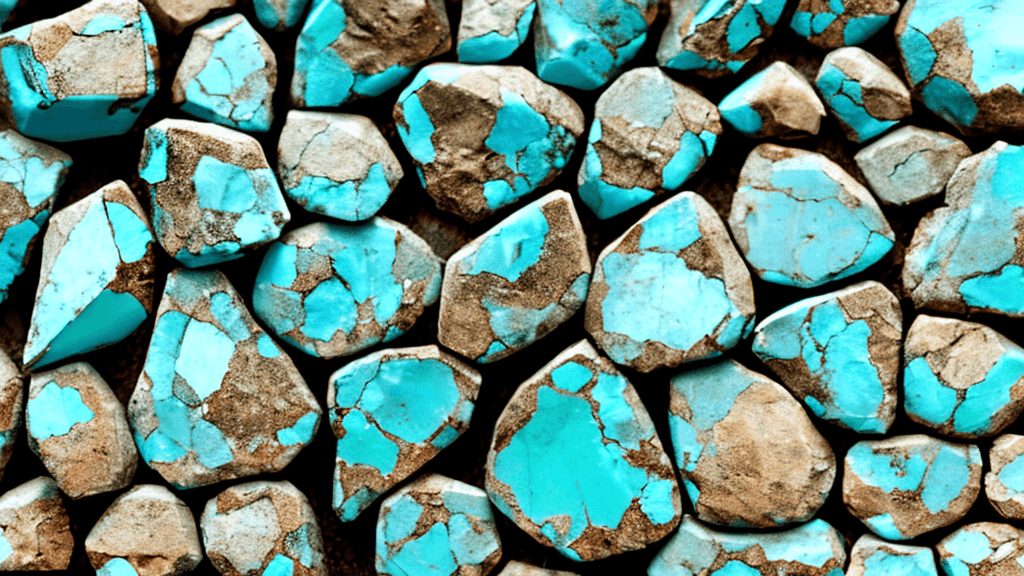
The signature blue-green color that makes turquoise so desirable isn't just one shade—it's a spectrum influenced by mineral chemistry. Understanding these variations helps identify both real turquoise and its quality grade.
Robin Egg Blue (Persian Blue)
The most prized color, this pure sky blue results from minimal iron and maximum copper content. Iranian mines historically produced the finest examples, though American Southwest deposits occasionally yield similar quality. This color indicates:
- High copper content (Cu²⁺ ions)
- Low iron contamination
- Minimal zinc presence
- Premium market value
Blue-Green Spectrum
Most turquoise falls somewhere between pure blue and greenish-blue. The green tint increases with iron content, creating:
- Teal tones with moderate iron
- Greenish-blue with higher iron
- Yellow-green tints from zinc or iron variations
Matrix Patterns
The spider web matrix—thin dark lines crossing the stone—isn't a flaw but a feature. These patterns form when turquoise replaces host rock, creating:
- **Spider web**: Fine, interconnected dark lines
- **Boulder matrix**: Host rock fragments within turquoise
- **Pyrite inclusions**: Metallic flecks indicating specific deposits
What Causes Color Changes
Turquoise color isn't static. Several factors can alter appearance over time:
Natural Color Stability
High-quality blue turquoise typically maintains color better than green varieties. The copper-aluminum phosphate bonds in premium specimens resist environmental changes, while iron-rich green stones may slowly shift toward brownish tones.
Light and Heat Effects
Prolonged sunlight exposure can gradually fade turquoise, especially treated stones. Heat from jewelry repair or improper storage accelerates this process. Store specimens away from direct sunlight and heat sources.
Chemical Sensitivity
Turquoise's porous nature makes it vulnerable to:
- Skin oils and cosmetics (can darken surface)
- Perfumes and hairspray (may create surface films)
- Household chemicals (can etch or discolor)
- Even natural body chemistry variations
Geographic Sources: Where Real Turquoise Forms
Worldwide Deposits
Understanding turquoise origins helps with identification because each locality produces characteristic features. While turquoise occurs globally, certain regions produce distinctly identifiable material.
Iran (Persia)
The ancient mines near Nishapur set the standard for "Persian turquoise." Characteristics include:
- Pure robin egg blue color
- Minimal matrix (often called "sleeping beauty" quality)
- Hard, dense material taking excellent polish
- Historical significance dating to 5000 BCE
Egypt's Sinai Peninsula
The world's oldest known turquoise mines (operated 7,000+ years ago) produce:
- Greenish-blue colors
- Distinctive dark blue-black matrix
- Often softer material requiring stabilization
- Archaeological importance exceeding gem value
China's Hubei Province
Modern production centers yield:
- Wide color range from blue to green
- Extensive spider web matrix patterns
- Often requires treatment for stability
- More affordable than Persian or American material
American Turquoise Sources
The American Southwest represents the world's most diverse turquoise province, with each mine producing identifiable characteristics. Learning these helps identify real turquoise and often specific origins.
Sleeping Beauty Mine, Arizona
- Famous sky-blue color without matrix
- Hard, stable material
- Mine closed in 2012, increasing value
- Often imitated by dyed treatments
Bisbee Mine, Arizona
- Distinctive dark blue with red-brown matrix
- High-quality spider web patterns
- Limited production from copper mine byproduct
- Premium prices for choice material
Morenci Mine, Arizona
- Bright blue with pyrite inclusions
- Metallic pyrite flecks distinguish from other sources
- Large-scale copper mining operation
- Variable quality from different mine levels
Nevada's Many Mines
Nevada produces the most diverse American turquoise:
- **Carico Lake**: Lime green colors from zinc content
- **Pilot Mountain**: Blue-green with complex matrix
- **Royston**: Wide color range from single district
- **Landers**: Deep blue with black matrix
New Mexico Sources
- **Cerrillos**: America's oldest mines, historic significance
- **Mines in the Burro Mountains**: Blue to green colors
- **Hachita District**: Limited production, collector interest
Identifying Turquoise by Source
Experienced collectors often identify turquoise origin by specific characteristics. While not foolproof, these features provide clues:
- **Matrix color and pattern**: Each mine's host rock creates distinctive matrix
- **Color saturation**: Local geology affects trace elements
- **Hardness variations**: Different deposits produce varying stability
- **Associated minerals**: Presence of specific companion minerals
Distinguishing Real Turquoise from Fakes
The Howlite Problem
Howlite, a naturally occurring white mineral, has become the primary turquoise fake. Its porous structure accepts dye beautifully, creating convincing imitations sold at premium prices. Here's how to spot howlite masquerading as turquoise:
Visual Clues
- **Overly uniform color**: Real turquoise shows natural color variations
- **White spots or streaks**: Undyed howlite showing through
- **Too-perfect matrix**: Dyed howlite often shows artificial-looking black lines
- **Chalky appearance**: Missing turquoise's characteristic waxy luster
Physical Tests
- **Scratch test**: Howlite (hardness 3.5) scratches much easier than real turquoise
- **Acetone test**: Rubbing alcohol or acetone removes dye from howlite
- **Magnification**: Dyed howlite shows dye concentration in pores and cracks
Plastic and Resin Composites
Modern manufacturing creates frighteningly convincing fake turquoise from plastic composites. These materials often appear in:
- **Beaded jewelry**: Uniform beads with perfect color matching
- **Large carvings**: Pieces too large for natural turquoise formation
- **Inexpensive items**: "Turquoise" selling below market value
Identification techniques:
- **Weight test**: Plastics feel noticeably lighter than real stone
- **Hot needle test**: Heated pin melts plastic (use cautiously)
- **Sound test**: Plastic pieces click differently when tapped together
- **Temperature test**: Plastics warm quickly in hand, staying warmer than stone
Reconstituted Turquoise
This deceptive practice involves grinding real turquoise scraps, mixing with resin, and forming "stones." While containing some turquoise, these materials lack natural stone properties.
Warning signs:
- **Too-perfect appearance**: Uniform color and texture
- **Air bubbles**: Visible under magnification
- **Uneven hardness**: Different wear patterns across the piece
- **Price too good**: High-quality appearance at low prices
Stabilized vs Natural Turquoise
Not all treatments create fakes. Stabilization uses clear resins to strengthen porous turquoise, common and accepted in the trade. However, understanding the difference matters for value and identification.
Natural turquoise characteristics:
- Higher value, especially for hard material
- May show more color variation
- Requires careful handling
- Often retains better long-term appearance
Stabilized turquoise features:
- More durable for jewelry use
- Color often enhanced but still natural
- Lower cost but still genuine turquoise
- Acceptable for most applications
Advanced Testing Methods
When visual identification proves inconclusive, several advanced techniques confirm turquoise authenticity:
Specific Gravity Testing
Weigh specimens in air and water to calculate density. Real turquoise falls within its characteristic 2.6-2.8 range, while most fakes differ significantly.
Refractive Index Testing
Gemological refractometers measure how light bends through specimens. Turquoise shows characteristic readings distinguishing it from common imitations.
Spectroscopic Analysis
Advanced laboratories use spectroscopy to identify chemical composition, definitively separating natural turquoise from synthetics.
UV Light Response
Some turquoise shows characteristic fluorescence under ultraviolet light, while many fakes react differently or not at all.
Turquoise Quality Grades and Values
Understanding Quality Factors
Turquoise value depends on multiple interacting factors. Learning these helps identify not just real turquoise, but its quality grade—a crucial skill for collectors and dealers.
Color Assessment
The most valuable turquoise displays pure, intense blue color without greenish tints. However, color preference varies culturally and personally.
- **Persian blue**: Premium sky blue commands highest prices
- **Blue-green**: Popular in American markets, moderate premium
- **Green**: Less valuable but desirable for certain applications
- **Pale colors**: Lower value unless rare matrix patterns appear
Matrix Patterns and Appeal
Matrix affects both beauty and value, though preferences vary:
- **Spider web**: Thin, even dark lines increase value significantly
- **Boulder matrix**: Host rock fragments create unique patterns
- **Pyrite inclusions**: Metallic flecks add interest and value
- **Clean material**: No matrix also commands premium when color is excellent
Hardness and Stability
Hard, stable turquoise requires no treatment and maintains appearance indefinitely. Softer material may need stabilization, affecting value.
Professional Grading Systems
While no universal grading system exists, most dealers recognize these categories:
High Grade (Gem Grade)
- Hard, stable natural material
- Excellent color saturation
- Minimal or attractive matrix
- Suitable for fine jewelry without treatment
- Prices: $100-$1,000+ per carat for top specimens
Medium Grade
- Good color but may need stabilization
- Attractive matrix patterns
- Suitable for most jewelry applications
- Prices: $20-$100 per carat
Low Grade (Chalk Turquoise)
- Soft, porous material
- Poor color or excessive matrix
- Requires stabilization for use
- Prices: $1-$20 per carat
Investment Considerations
Quality turquoise has appreciated steadily, particularly:
- **Closed mines**: Sleeping Beauty prices tripled after closure
- **Exceptional specimens**: Museum-quality pieces outperform market
- **Provenance documented**: Verified source increases value
- **Natural untreated**: Premium increases as treatments become common
Common Identification Mistakes to Avoid
Relying on Single Tests
Perhaps the biggest mistake in turquoise identification is depending on one characteristic. Real turquoise shows variation, while fakes often appear too perfect. Always combine multiple identification methods.
Mistake: Assuming all blue-green stones are turquoise
Reality: Chrysocolla, variscite, and other minerals mimic turquoise
Mistake: Trusting color alone
Reality: Excellent fakes reproduce color perfectly
Mistake: Ignoring accompanying minerals
Reality: Associated minerals often indicate authenticity
Misunderstanding Treatments
Not all treatments create fakes, but misunderstanding them leads to valuation errors:
Stabilization confusion: Acceptable treatment versus complete fraud
Color enhancement: Minor improvement versus complete transformation
Composite materials: Partially real versus entirely fake
Cultural Misconceptions
Many collectors assume all Native American jewelry contains natural turquoise. However, indigenous artisans have used treatments for centuries, and modern craftspeople may use stabilized material for durability.
Price-Based Assumptions
"Expensive means real" fails regularly in turquoise markets. Some dealers charge premium prices for sophisticated fakes, while legitimate stabilized material sells for reasonable prices.
Care and Cleaning Instructions
Daily Care Essentials
Turquoise's relative softness and porosity require special handling. Unlike harder gems, turquoise absorbs chemicals and shows wear more readily.
Storage Guidelines
- Store separately from harder gemstones
- Use soft pouches or individual compartments
- Avoid airtight containers that trap moisture
- Keep away from direct sunlight and heat sources
Wearing Precautions
- Apply cosmetics and perfumes before putting on turquoise jewelry
- Remove before swimming, bathing, or hand washing
- Take off during sports or heavy labor
- Avoid exposure to household chemicals
Cleaning Methods
Never use standard jewelry cleaners on turquoise. The chemicals and ultrasonic energy damage the stone's surface and may remove treatments.
Safe Cleaning Technique
- Use only warm water and mild soap
- Gently wipe with soft cloth or very soft brush
- Rinse thoroughly but quickly
- Dry immediately with soft, absorbent cloth
- Allow complete air drying before storage
What to Avoid
- Ultrasonic cleaners
- Steam cleaning
- Ammonia or bleach solutions
- Commercial jewelry dips
- Abrasive polishing compounds
- Extended water immersion
Long-term Preservation
Turquoise can maintain beauty for generations with proper care. Key factors include:
Environmental Control
- Stable temperature and humidity
- Protection from prolonged light exposure
- Avoidance of chemical atmospheres
- Regular gentle cleaning to remove accumulated oils
Professional Maintenance
- Have settings checked annually
- Request jewelers experienced with turquoise
- Avoid re-polishing unless absolutely necessary
- Document any professional treatments for future reference
Historical and Cultural Significance
Ancient Civilizations
Turquoise claims one of the longest gem-use histories, with archaeological evidence dating back 7,000+ years. Understanding this heritage adds appreciation beyond mere identification.
Egyptian Empire
Ancient Egyptians valued turquoise above all gems except lapis lazuli. The oldest known mines in Sinai operated by 5000 BCE, producing material for:
- Pharaohs' burial ornaments
- Ceremonial jewelry
- Amulets and protective talismans
- Trade throughout Mediterranean civilizations
Persian Culture
Iranian turquoise became the standard for "perfect" color, influencing gem appreciation across cultures. Persian mines supplied:
- Royal treasuries throughout Middle East
- European courts during Medieval period
- Asian trade routes reaching China and India
- Modern jewelry markets still seeking "Persian blue"
Native American Heritage
No culture integrated turquoise more completely than Southwestern Native American peoples. For many tribes, turquoise transcends decoration to embody spiritual significance.
Pueblo Peoples
Pre-Columbian miners worked New Mexico's Cerrillos deposits centuries before Spanish arrival. Turquoise appeared in:
- Ceremonial objects
- Trade networks extending to Mexico
- Burial goods indicating status
- Daily wear for protection and blessing
Navajo (Diné) Tradition
The Navajo view turquoise as pieces of sky fallen to earth, using it extensively in:
- Squash blossom necklaces
- Concho belts
- Ceremony-specific jewelry
- Modern innovations maintaining tradition
Zuni Artistry
Zuni artisans developed intricate inlay techniques, creating:
- Detailed animal fetishes
- Complex mosaic patterns
- Cluster work combining multiple stones
- Contemporary adaptations of traditional designs
Modern Appreciation
Contemporary collectors value turquoise for multiple reasons beyond beauty:
Investment Potential
Quality turquoise has appreciated consistently, especially material from closed mines. As natural deposits deplete, premium specimens command increasingly higher prices.
Cultural Preservation
Collecting authentic pieces supports indigenous artists and helps maintain traditional techniques that might otherwise disappear.
Scientific Interest
Geologists study turquoise formation to understand copper deposits and ancient environmental conditions, while archaeologists use it to trace trade routes and cultural interactions.
Building Your Turquoise Collection
Starting Strategies
Beginning collectors should focus on education before acquisition. Understanding identification principles prevents expensive mistakes and builds confidence.
Initial Purchases
- Buy from reputable dealers who guarantee authenticity
- Start with modest specimens to practice identification
- Document sources and prices for future reference
- Join rockhound clubs to learn from experienced collectors
Building Expertise
- Handle as much genuine material as possible
- Study examples of common fakes
- Visit museums with turquoise collections
- Attend gem and mineral shows for comparison opportunities
Advanced Collecting
Experienced collectors often specialize in particular aspects:
Geographic Focus
- Concentrating on specific mining districts
- Building complete locality suites
- Documenting regional variations
- Networking with area-specific dealers
Type Specialization
- Natural versus treated material
- Matrix pattern preferences
- Historical pieces with provenance
- Contemporary artisan work
Using Technology for Identification
Modern tools enhance traditional identification methods. The Rockhound app's AI identification feature helps confirm field finds, while reference databases provide instant comparison images.
Photography Tips
- Document specimens in natural light
- Include scale references
- Capture matrix patterns clearly
- Maintain digital catalogs for insurance and reference
Record Keeping
- Purchase dates and prices
- Seller information and guarantees
- Any subsequent testing or authentication
- Market value updates for insurance
Conclusion: Your Journey to Turquoise Expertise
Mastering turquoise identification combines scientific knowledge, practical experience, and appreciation for this remarkable mineral's cultural significance. From understanding physical properties to recognizing quality grades, each skill builds toward confident identification of real turquoise versus sophisticated fakes.
Remember that expertise develops gradually through handling genuine specimens, learning from mistakes, and staying curious about new finds. Whether you're rock hunting in the Southwest, browsing estate sales, or evaluating online offerings, these identification skills protect your investments while deepening appreciation for genuine turquoise.
The rock collecting community thrives on shared knowledge and ethical collecting practices. By applying these identification principles, you contribute to preserving turquoise's legacy while building a meaningful collection that might span generations.
Ready to put your new knowledge into practice? Download the Rockhound app to identify specimens in the field, track your collecting locations, and connect with fellow enthusiasts. The AI identification feature helps confirm your visual assessments, while GPS tracking ensures you never forget that perfect collecting spot again.
Happy hunting, and may your next expedition reveal genuine turquoise treasures that rival the finest museum specimens!
Ready to start hunting?
Download Rockhound and identify your finds instantly with AI-powered recognition. Track your expeditions with GPS and build your digital collection.
Download Rockhound