How to Identify Obsidian: Types, Colors & Formations
Learn how to identify obsidian like a pro with our comprehensive guide. Discover different types of obsidian, color variations, where to find them, and how to distinguish genuine obsidian from look-alikes.
In this article
- What is Obsidian? Understanding This Natural Glass
- Types of Obsidian: A Complete Visual Guide
- Color Variations and What Causes Them
- Where to Find Obsidian: Prime Hunting Locations
- How to Distinguish Obsidian from Similar Materials
- Common Mistakes in Obsidian Identification
- Value and Collectibility: What's Your Obsidian Worth?
- Care and Cleaning Instructions
- Historical and Cultural Significance
- Using Technology to Enhance Your Obsidian Hunting
- Building Your Obsidian Collection: A Systematic Approach
# How to Identify Obsidian: Types, Colors & Formations
Obsidian is one of nature's most fascinating creations - natural volcanic glass formed when lava cools so rapidly that crystals don't have time to grow. For rockhounds and mineral collectors, learning to properly identify obsidian opens up a world of beautiful specimens, from the classic black variety to stunning rainbow obsidian that seems to glow from within.
Whether you're a beginner rock hunter just starting your collection or an experienced collector looking to expand your knowledge, this comprehensive guide will teach you everything you need to know about obsidian identification. We'll cover physical properties, color variations, formation locations, and how to distinguish genuine obsidian from similar-looking materials.
What is Obsidian? Understanding This Natural Glass
Before diving into identification techniques, it's crucial to understand what makes obsidian unique. Unlike most rocks and minerals, obsidian isn't crystalline - it's an amorphous solid, meaning its atoms are arranged randomly rather than in an orderly crystal structure.
The Science Behind Obsidian Formation
Obsidian forms when felsic lava (rich in silica) cools almost instantaneously. This rapid cooling prevents the formation of mineral crystals, creating a uniform glassy texture. The process typically occurs:
- At the edges of lava flows where cooling is fastest
- When lava encounters water or ice
- During volcanic explosions that eject molten material into the air
Key Identifying Characteristics
When learning to identify obsidian, these are the fundamental characteristics to remember:
Physical Properties:
- **Hardness:** 5-5.5 on the Mohs scale (can scratch glass but not quartz)
- **Luster:** Vitreous (glassy) to sub-vitreous
- **Crystal System:** None (amorphous)
- **Specific Gravity:** 2.3-2.6 (slightly heavier than average rock)
- **Fracture:** Conchoidal (curved, shell-like breaks)
- **Streak:** White to gray
The conchoidal fracture is perhaps the most distinctive feature - when obsidian breaks, it creates curved surfaces with sharp edges, similar to broken glass. This property made obsidian invaluable to ancient peoples for tool-making.
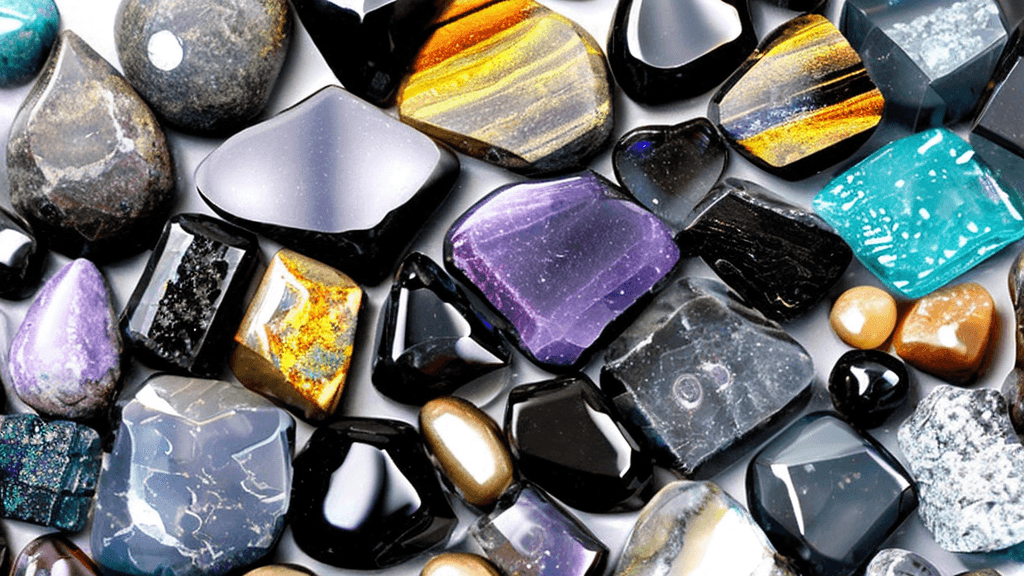
Types of Obsidian: A Complete Visual Guide
Understanding the different types of obsidian is essential for accurate identification. Each variety has unique characteristics that tell a story about its formation and composition.
Black Obsidian
The most common variety, black obsidian appears deep black to dark brown in transmitted light. High-quality specimens are completely opaque with a mirror-like shine.
Identification tips:
- Hold to strong light - may appear dark brown or show faint banding
- Surface should be uniformly glassy without pitting
- Fracture edges should be extremely sharp
Rainbow Obsidian
Perhaps the most sought-after variety, rainbow obsidian displays iridescent bands of color when viewed in strong light. These colors result from microscopic mineral inclusions arranged in layers.
How to identify rainbow obsidian:
- Colors appear as metallic sheens, not solid colors
- Best viewed in bright, angled light
- Quality specimens show multiple colors (purple, green, gold, blue)
- Colors should appear to float beneath the surface
Mahogany Obsidian
This variety contains iron oxide impurities creating brown to reddish-brown bands or swirls within the black glass. The patterns can be subtle or quite dramatic.
Identification features:
- Distinct brown/red bands in black matrix
- Bands may be straight, curved, or swirling
- Color concentration varies from light to dark
- Should still retain glassy luster
Snowflake Obsidian
Characterized by white or gray spherulitic inclusions of cristobalite (a form of quartz), snowflake obsidian appears to have snowflakes scattered throughout the black glass.
Key identifiers:
- White/gray spots are three-dimensional, not just surface markings
- Spots are typically round or oval
- Distribution can be sparse or dense
- Each "snowflake" is actually a small radiating cluster
Apache Tears
These are small, rounded pebbles of obsidian found in perlite deposits. According to legend, they represent the tears of Apache women mourning their fallen warriors.
How to identify Apache tears:
- Small size (typically under 2 inches)
- Rounded, water-worn appearance
- Often found embedded in gray perlite matrix
- May appear dull until tumbled or broken
Fire Obsidian
One of the rarest varieties, fire obsidian from Oregon displays brilliant colors in thin layers, created by light interference effects similar to opal.
Identification characteristics:
- Found only in specific Oregon locations
- Colors appear as thin layers
- Requires proper cutting to reveal colors
- Extremely rare and valuable
Color Variations and What Causes Them
Understanding obsidian's color variations helps explain why this natural glass appears in such diverse forms. Each color tells a chemical story about the obsidian's formation.
Chemical Colorants in Obsidian
Black Coloration:
- Caused by magnetite and hematite microcrystals
- Iron content typically 2-4%
- More iron = darker color
Brown/Red Colors:
- Iron oxide (Fe2O3) creates mahogany patterns
- Oxidation state affects final color
- Higher oxygen availability during formation = more red tones
Rainbow Effects:
- Not caused by coloring agents
- Result from light interference by microscopic layers
- Similar to how oil creates rainbow colors on water
Regional Color Variations
Different volcanic regions produce obsidian with characteristic color patterns:
- **Oregon:** Known for fire obsidian and high-quality rainbow varieties
- **California:** Produces excellent black and snowflake obsidian
- **Mexico:** Famous for exceptional rainbow and velvet obsidian
- **Iceland:** Creates dark, almost pure black obsidian
Where to Find Obsidian: Prime Hunting Locations
Successful obsidian hunting starts with knowing where to look. This volcanic glass forms in specific geological settings that rockhounds can learn to recognize.
Major Obsidian Deposits in the United States
Oregon:
- Glass Buttes (Lake County) - World's premier obsidian locality
- Multiple varieties including fire, rainbow, and midnight lace obsidian
- Free collecting on BLM land with certain restrictions
- Bring sturdy vehicles for rough road access
California:
- Coso Mountains (Inyo County) - Extensive deposits
- Medicine Lake Highlands - Excellent snowflake obsidian
- Obsidian Dome near Mammoth Lakes - Educational site
- Some areas require permits or have seasonal restrictions
Arizona:
- Superior area - Apache tears locality
- Found in perlite deposits
- Often requires digging in abandoned quarries
- Best collected after rain when they're easier to spot
New Mexico:
- Jemez Mountains - Multiple flows accessible
- Bandelier National Monument - Look but don't collect
- Valles Caldera - Restricted access, research required
International Obsidian Localities
Mexico:
- State of Hidalgo - Famous rainbow obsidian deposits
- Can be collected with proper permits
- Local guides recommended for remote areas
Iceland:
- Hrafntinnusker - "Obsidian Skerry" in Icelandic
- Part of popular Laugavegur hiking trail
- Protected area, no collecting allowed
Italy:
- Lipari Islands - Historic obsidian source
- Museum collections showcase ancient mining
- Modern collecting heavily restricted
Japan:
- Mount Kusatsu-Shirane - Active volcanic area
- Hokkaido locations - Good quality specimens
- Check local regulations before collecting
GPS Coordinates for Popular Sites
When planning your obsidian hunting expedition, use these GPS coordinates as starting points:
- Glass Buttes, Oregon: 43.5206° N, 120.2547° W
- Coso Mountains, California: 36.1681° N, 117.8842° W
- Apache Leap, Arizona: 33.2478° N, 111.1654° W
Always verify current collecting regulations and land ownership before visiting.
How to Distinguish Obsidian from Similar Materials
One of the most challenging aspects of obsidian identification is distinguishing it from other dark, glassy materials. Here's how to separate genuine obsidian from common look-alikes.
Obsidian vs. Black Glass (Man-made)
Natural Obsidian:
- Contains tiny flow lines or bands
- May have small phenocrysts or inclusions
- Shows conchoidal fracture with sharp edges
- Slightly variable thickness and shape
- Contains microscopic mineral crystals
Manufactured Glass:
- Perfectly uniform texture
- No natural inclusions or flow structures
- May contain air bubbles
- Often has mold marks or machine patterns
- Breaks with more regular fracture patterns
Obsidian vs. Onyx
Obsidian:
- Glassy luster
- Conchoidal fracture
- Amorphous structure
- Slightly lighter (2.3-2.6 specific gravity)
Onyx:
- Waxy to dull luster
- Uneven to conchoidal fracture
- Banded crystalline structure
- Heavier (2.65-2.75 specific gravity)
Obsidian vs. Jet
Obsidian:
- Vitreous luster
- Harder (5-5.5 Mohs)
- Conchoidal fracture
- Cools quickly to touch
Jet:
- Dull to waxy luster
- Softer (2.5-4 Mohs)
- Uneven fracture
- Warms quickly in hand (organic origin)
Obsidian vs. Tourmaline
Obsidian:
- Amorphous
- Single color throughout
- Glassy appearance
- Uniform texture
Tourmaline:
- Crystalline structure
- May show color zoning
- Sub-vitreous luster
- Prismatic crystal habit
Common Mistakes in Obsidian Identification
Even experienced rockhounds can make errors when identifying obsidian. Being aware of these common pitfalls will improve your identification accuracy.
Mistake 1: Confusing Weathered Obsidian with Other Rocks
Weathered obsidian develops a dull, chalky rind that can make it nearly unrecognizable. This alteration, called devitrification, occurs when the glass slowly crystallizes over thousands of years.
Solution: Look for fresh breaks or window the specimen by chipping a small piece to reveal the fresh glassy interior.
Mistake 2: Assuming All Black Glass is Obsidian
Many beginners assume any black, glassy material is obsidian. However, slag glass from industrial processes is common in many areas.
Solution: Check for flow lines, natural inclusions, and proper fracture patterns. Slag often contains vesicles (gas bubbles) and has a more uniform texture.
Mistake 3: Overlooking Apache Tears
These rounded obsidian pebbles can appear dull and unremarkable, leading collectors to pass them by.
Solution: Carry a small spray bottle. Wetting suspected Apache tears reveals their glassy nature and helps them stand out from other pebbles.
Mistake 4: Judging by Color Alone
Rainbow and fire obsidian can appear dull black in poor lighting, leading to misidentification.
Solution: Always examine potential obsidian specimens in bright, angled light. Carry a bright flashlight or use your phone's light to check for color play.
Value and Collectibility: What's Your Obsidian Worth?
Understanding obsidian's value helps collectors make informed decisions about which specimens to add to their collections and when to invest in higher-quality pieces.
Factors Affecting Obsidian Value
Rarity of Variety:
- Common black obsidian: $0.50-2 per pound
- Snowflake obsidian: $2-5 per pound
- Mahogany obsidian: $3-8 per pound
- Rainbow obsidian: $10-50+ per pound
- Fire obsidian: $100-500+ per pound
Quality Indicators:
- Color intensity and distribution
- Clarity of patterns
- Size of displayable pieces
- Absence of cracks or flaws
- Quality of polish (for finished pieces)
Size Considerations:
- Collector specimens: 2-10 inches most desirable
- Museum pieces: 12+ inches with exceptional features
- Lapidary rough: 1-5 pound pieces preferred
Market Trends and Collecting Tips
The obsidian market has seen increased interest in recent years, particularly for display specimens and high-quality lapidary material. Rainbow obsidian from premium localities commands the highest prices, especially pieces showing multiple colors.
Investment Pieces to Look For:
- Large rainbow obsidian with multiple colors
- Exceptional fire obsidian showing bright colors
- Unique pattern formations in mahogany obsidian
- Historical Apache tears with documentation
- Rare double-terminated crystals (extremely uncommon)
When building your collection, focus on acquiring the best examples you can afford rather than numerous mediocre pieces. Quality specimens from classic localities tend to hold value better than common material.
Care and Cleaning Instructions
Proper care ensures your obsidian specimens remain beautiful for years to come. This natural glass requires specific handling due to its unique properties.
Basic Cleaning Methods
For Fresh Specimens:
- Rinse with warm water to remove loose dirt
- Use mild dish soap if needed
- Scrub gently with soft brush
- Rinse thoroughly and air dry
- Avoid thermal shock (don't use hot water on cold specimens)
For Tumbled or Polished Pieces:
- Use only mild soap and water
- Dry with soft, lint-free cloth
- Handle with cotton gloves to prevent fingerprints
- Store wrapped in soft material
What to Avoid
Never Use:
- Ultrasonic cleaners (can cause fracturing)
- Acidic or alkaline solutions
- Abrasive cleaners or scrubbers
- Extreme temperature changes
- Steam cleaning
Storage Considerations:
- Keep away from harder materials that could scratch
- Store in padded containers or display cases
- Control humidity to prevent devitrification
- Avoid direct sunlight on polished surfaces
Repair and Restoration
Minor chips in obsidian are permanent, but professional lapidaries can sometimes re-polish damaged surfaces. For valuable specimens, consult experts rather than attempting DIY repairs.
Historical and Cultural Significance
Obsidian's unique properties have made it one of the most culturally significant materials throughout human history. Understanding this context adds depth to any collection.
Prehistoric Tool Making
For over 700,000 years, humans have used obsidian for tools and weapons. Its conchoidal fracture creates edges sharper than surgical steel - some obsidian blades have edges measuring just 3 nanometers thick.
Major Archaeological Sources:
- Anatolia (Turkey): 12,000+ years of exploitation
- Mesoamerica: Extensive trade networks
- North America: Pacific Northwest quarries
- Mediterranean: Aegean island sources
Trade Networks and Economy
Obsidian's distinctive chemical signature allows archaeologists to trace ancient trade routes. Major distribution networks operated across:
- The Mediterranean (3000+ km routes)
- Mesoamerica (1000+ km from source)
- North America (extensive Pacific networks)
Spiritual and Cultural Beliefs
Many cultures attributed special powers to obsidian:
Aztec Culture:
- Used for divination mirrors
- Associated with Tezcatlipoca ("Smoking Mirror")
- Believed to reveal hidden truths
Native American:
- Apache tears legend
- Protection against negative energy
- Used in healing ceremonies
Modern Crystal Healing:
- Grounding and protection stone
- Emotional healing properties
- Meditation aid
Modern Applications
Beyond collecting, obsidian finds use in:
- Surgical scalpel blades (experimental)
- Jewelry and decorative objects
- Metaphysical practices
- Scientific research (dating volcanic eruptions)
Using Technology to Enhance Your Obsidian Hunting
Modern technology has revolutionized how rockhounds identify and document their finds. While traditional identification skills remain essential, digital tools can significantly enhance your collecting experience.
GPS and Mapping Apps
Use specialized apps to mark productive locations, track your routes, and share finds with the collecting community. Many rockhounds use these tools to build personal databases of productive sites.
Digital Photography Tips
Documenting your obsidian finds requires specific techniques:
- Use indirect lighting to capture rainbow effects
- Include scale references in photos
- Photograph wet and dry specimens
- Take multiple angles to show fracture patterns
- Use macro mode for detailed shots
Online Resources and Communities
Connect with other collectors through:
- Specialized Facebook groups
- Rock hunting forums
- Instagram communities
- Local club websites
- Educational YouTube channels
Building Your Obsidian Collection: A Systematic Approach
Starting an obsidian collection requires planning and knowledge. Here's a systematic approach to building a meaningful collection.
Setting Collection Goals
Beginner Focus:
- Acquire representative samples of major varieties
- Learn basic identification skills
- Visit accessible localities
- Document finds properly
Advanced Collecting:
- Seek exceptional specimens
- Focus on specific varieties or localities
- Network with other serious collectors
- Consider investment potential
Essential Tools for Collection
Field Equipment:
- Rock hammer with chisel edge
- Safety glasses and gloves
- Collection bags or buckets
- Spray bottle for wetting specimens
- GPS device or smartphone app
Identification Tools:
- 10x magnifying loupe
- Steel nail for hardness testing
- Ceramic tile for streak tests
- Strong flashlight
- Reference books or apps
Documentation Best Practices
Maintain detailed records including:
- Collection date and location
- GPS coordinates
- Field observations
- Photographs
- Purchase information (if bought)
Conclusion: Your Journey in Obsidian Identification
Mastering obsidian identification opens up a world of fascinating collecting opportunities. From the sharp edges of freshly broken black obsidian to the mesmerizing colors of rainbow varieties, each specimen tells a story of volcanic forces and rapid transformation.
Remember that becoming proficient at obsidian identification takes practice. Start with common varieties, visit known localities when possible, and always continue learning from each specimen you encounter. The skills you develop identifying obsidian will serve you well in other areas of mineral and rock identification.
Whether you're drawn to obsidian for its natural beauty, historical significance, or scientific interest, this remarkable natural glass offers something for every collector. Take time to appreciate both the aesthetic qualities and the geological processes that created each piece in your collection.
Ready to put your new knowledge into practice? The [Rockhound app](https://getrockhound.com) can be your perfect companion in the field, helping you identify obsidian specimens instantly with AI-powered recognition. Simply snap a photo, and the app will analyze key features to help confirm your identification. Plus, with offline GPS tracking, you can mark your best collecting spots and navigate back to them safely, even without cell service.
Download Rockhound today from the [App Store](https://apps.apple.com/us/app/rockhound-rock-identifier/id6758138903) and join thousands of rockhounds who are discovering, identifying, and collecting amazing minerals worldwide. Happy hunting!
---
Have questions about obsidian identification or want to share your amazing finds? Connect with fellow collectors in the Rockhound community and continue your learning journey!
Ready to start hunting?
Download Rockhound and identify your finds instantly with AI-powered recognition. Track your expeditions with GPS and build your digital collection.
Download Rockhound