Display Ideas for Your Rock Collection: From Casual to Museum-Quality
Learn how to showcase your rock and mineral collection like a pro. This comprehensive guide covers everything from budget-friendly shelves to museum-quality display cases, with step-by-step instructions and pro tips.
In this article
You’ve hiked miles to [find the perfect specimens](INTERNAL: beginner guide), identified them with Rockhound’s AI, and now they’re sitting in a shoebox under your bed. Sound familiar? Let’s fix that. Whether you’ve got a dozen beach agates or a basement full of museum-grade tourmaline, this guide will walk you through rock collection display ideas that protect your treasures, tell their stories, and actually make you want to show them off.
Quick-Start: 5 Questions Before You Build Anything
- How many pieces need face time? (Count everything—yes, even those crumbly quartz chunks you’ll never throw away.)
- What’s the biggest rock? Measure length × width × height; add 2 cm clearance on every side.
- Do you have kids, cats, or earthquakes? (Honest answers prevent future heartbreak.)
- What’s your budget tier: Shoebox ($0–25), Starter ($25–150), Serious ($150–500), or Gallery ($500+)?
- Will you rotate pieces or keep it static? (Rotation needs modular shelves or trays.)
Answer these five lines and skip straight to the matching section below—you’ll save hours and dollars.
Rock Collection Display Styles: Which One Fits You?
1. Casual Cubby: Shoebox to Stylish in 30 Minutes
Perfect for kids, dorm rooms, or brand-new rockhounds who haven’t [cataloged anything yet](INTERNAL: how to catalog collection).
What it looks like:
- Egg-carton sections lined with felt
- Muffin tins spray-painted matte black
- Clear acrylic nail-polish racks ($12 on marketplace sites)
Pros: Free/cheap, zero skills required, rocks stay put when you move.
Cons: Zero UV protection, dust city, not impressive on Instagram.
Step-by-step:
- Wash rocks, let dry 24 h.
- Hot-glue a 1 cm bead of rice-sized gravel to the bottom of each cell—creates airflow so unseen moisture doesn’t fog the plastic.
- Label bottoms with tiny dot stickers; write catalog number so you can look up ID in Rockhound later.
- Snap a photo of the full tray and upload it to the app’s “Display” album so you never forget what’s where.
2. Starter Shelf: Bookshelf Make-over for Under $75
The most common first “real” display. You probably already own the furniture.
Materials list (budget level):
- 3-tier bamboo bathroom shelf ($25) or existing bookcase (free)
- Adhesive LED strip lights, 6000 K daylight ($18)
- 1×2 pine furring strip, 8 ft ($6)
- Velcro-style museum putty ($8)
- Clear polyurethane spray ($6)
- Black poster board ($3)
Tools: Hand saw or miter box, 150-grit sandpaper, drill with 1⁄16″ bit, screwdriver.
Build steps:
- Cut furring strip into 4″ pegs; drill angled pilot holes; screw into sides of bookcase every 8″ to create hidden mini-shelves for thumbnail specimens.
- Spray three light coats of polyurethane on pegs and shelf surface—keals off dust-attracting sap.
- Line back with matte-black board; the void disappears and colors pop.
- Stick LED strip under each fixed shelf; daylight temp shows true colors and makes photos for Rockhound ID way easier.
- Museum-putty every specimen larger than 2″—survives 3-year-old climbers and 5.0 earthquakes.
Common mistake: Pointing LEDs straight down. Angle them 30° toward the back wall; you eliminate glare when you photograph.
3. Curio Cabinet: Intermediate Glass Showcase
You’re out of shelf space and starting to buy specimens that cost more than dinner—time for glass.
Shopping cheat-sheet:
- IKEA DETOLF ($79): 4-tall glass tower, #1 choice in Facebook rock groups.
- Used china cabinet (Facebook Marketplace, $50–150): bigger, cheaper, heavier.
- After-market lockset ($12) if you have toddlers.
Pro upgrade sequence:
- Replace stock shelves with ¼″ low-iron glass (call local glass shop, ~$25 per shelf). Low-iron glass removes the green edge that mutes amethyst purples and fluorite greens.
- Add 1″ aluminum channel LED bars, 5000 K, CRI > 90. CRI (Color Rendering Index) above 90 keeps rhodochrosite from looking like pink plastic.
- Install invisible mirror film on the back wall—doubles visual depth for under $20.
- Use 3 lb-rated acrylic risers ($1 each at thrift stores as “picture frame backs”) to stagger heights; light hits more faces and makes shadows interesting.
Troubleshooting corner doors that won’t close:
- Put thin neoprene weather-strip along hinge side; pushes door out 1 mm so magnet catches.
- If you live in humid areas, add a 20 g rechargeable silica-gel canister under bottom shelf—keeps relative humidity below 45 % and prevents pyrite disease.
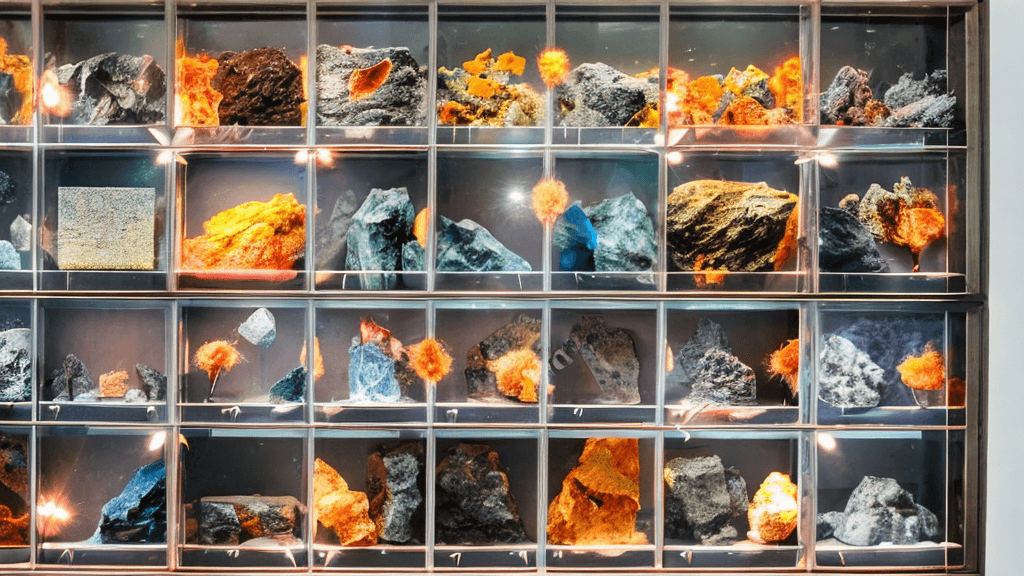
4. Museum-Quality Display Cases: When Rocks Turn to Art
You’re exhibiting at a gem show or you just want your mother-in-law to understand why you spend weekends in quarries.
Hallmarks of museum-grade:
- UV-filtering laminated glass (blocks 99 % up to 380 nm)
- Individual adjustable halogen or high-CRI LED spots (2700–3000 K for warmth, but still CRI 95+)
- Powder-coated steel or hardwood frames with seismic brackets
- Microclimate control: silent fan + silica-gel cartridge
- Locking system, preferably keyed-alike so ten cases open with one key
Budget reality check:
Ready-made: GEM-MC 48″ tower, $1,850 delivered.
DIY equivalent (woodworking skills required): $550 in materials + 20 hours labor.
Step-by-step mini-build:
- Source ¾″ birch ply; cut dado grooves ¼″ deep so glass slides in without brackets—cleaner sight-lines.
- Spray interior with matte-black latex; absorbs stray light so specimen color saturates.
- Mount 4 W, 3000 K, CRI 97 COB LEDs in aluminum track; add 30° honeycomb louvers to eliminate glare.
- silicone a 1″ vent slot top & bottom; hide 40 mm USB fan behind top grill; run at 5 V so it’s silent but circulates air.
- Add digital hygrometer visible from outside; swap silica-gel when RH hits 50 %.
Pro tip: Ask local museums what they do with decommissioned cases—many sell them for $50–200 when they remodel. You’ll get UV glass and locks for thrift-store prices.
Lighting 101: Making Colors Pop Without Fading Them
The 3 Numbers That Matter
- **Color temperature:** 5000–5500 K equals northern daylight; best for accurate ID photos you’ll upload to Rockhound. 2700–3000 K warmer, gallery vibe but can yellow quartz.
- **CRI:** Aim ≥ 90. Below that, rhodochrosite looks salmon, not rose-red.
- **UV output:** Measure in µW/lm; you want < 10. Cheap LEDs often have surprisingly high UV spikes that will fade amethyst to gray in under a year.
Cheap Test for UV Leakage
Grab a $5 bank-note checker UV flashlight. Turn off room lights, shine it on your display LED from 6″. If the paper currency security stripe glows, your display LED is leaking UV—swap it out.
Lighting Positions That Always Work
- **Single headline piece:** Top-down 45° angle, plus a low front fill at 15° to kill shadows.
- **Row of similar pieces:** Linear LED bar across front edge, angled 30° back—creates even wash.
- **Transparent crystals (quartz, calcite):** Back-light with a diffuser panel; front light only creates reflections.
Labels & Cataloging: Turn Pretty Rocks into a Story
A pretty rock without context is just a paperweight. Here’s the collector-secret formula every museum uses:
Minimum data set:
- Catalog number (link to Rockhound entry)
- Species name & variety (e.g., Quartz, amethyst var.)
- Locality, at least county & state, ideally GPS coordinates you saved in Rockhound
- Date collected
- Collector name (that’s you!)
Label styles by budget:
- **Free:** 10-point font on white paper, trim to 1 × 2″, stick with clear tape, spray with cheap matte acrylic so ink doesn’t run.
- **$0.25 each:** Brother P-touch laminated tape, black on white, 12 mm. Survives decades.
- **$1.50 each:** Laser-engraved 1 × 3″ black Rowmark UV-stable plastic; looks museum-grade, buy 50 at a time on marketplace sites.
Placement rule-of-thumb: Put label lower than the specimen’s midpoint; human eyes drop to read, and you avoid hiding the prettiest face.
Common Display Mistakes That Ruin Specimens
- **Sunny windowsill** – UV plus thermal cycling = cracked quartz and faded fluorite.
- **Kitchen display** – Cooking aerosols coat surfaces with sticky grease that’s almost impossible to remove from etched calcite.
- **Unsealed wooden shelves** – Acids in pine can create white bloom on zeolites in under a year; always seal or line with inert acrylic.
- **Over-tight screws on metal stands** – Micro-fractures travel, and a $500 tourmaline snaps when the stand flexes.
- **Rubber bumpers** – Many contain sulfur; leaves black tarnish prints on silver minerals like acanthite. Use pure silicone or museum putty instead.
Rotation & Storage: How to Swap Pieces Without Chaos
Even the best display gets stale. A simple A/B system keeps things fresh and protects overflow.
Build two “flat files” from shallow plastic photo boxes ($6 each). Line with 1 cm foam; number boxes and every cell; enter box/cell into Rockhound’s Storage field. When you swap, you know exactly where the previous piece lives—no lost garnets.
Pro rotation tip: Photograph the old layout before you pull pieces; reverse image makes re-install next season painless.
Kid-Proof & Pet-Proof Displays
- Use museum putty rated 5 lb per pea-sized dot; doubles as earthquake stabilization.
- Acrylic cases instead of glass—polycarbonate (Lexan) 250× stronger than glass, 30× more expensive but still cheaper than an ER visit.
- Wall anchor everything; a climbing cat generates 50–70 lb sideways force—your DETOLF will tip.
- Add silicone “bumpers” on inside corners so doors can’t slam; prevents vibration that can chip delicate specimens.
Budget Builds: 3 Complete Set-ups Under $100
$18 Muffin-Tin Travel Case
- 2 × 6-cup silicone muffin pans ($12)
- Dollar-store tackle lid strap ($2)
- Felt squares ($2)
- Velcro dots ($2)
Fits in a backpack, survives airport luggage, holds 12 thumbnail specimens. Great for kids’ show-and-tell.
$48 CSA (Cheap Shelf Array)
- 3 IKEA KNAGGLIG pine boxes ($10 each)
- 1 can flat-black spray ($6)
- 12 adhesive LED pucks ($12 total)
Stack boxes ladder-style; screw to wall; run LEDs off USB power bank. Holds 30–40 small specimens.
$92 China-Cabinet Flip
- Used 4′ china cabinet (Facebook Marketplace) ($50)
- Replacement low-iron glass shelf ($25)
- Silica-gel canister ($10)
- Magnetic child locks ($7)
Looks high-end, locks keep small fingers out, humidity stays low enough for pyrite.
Gallery Inspiration: 4 Real Collectors & Their Set-ups
Case 1 – The Apartment Geologist 600 sq-ft rental, 300 specimens. Used three DETOLF towers lined up as a room divider. Added IKEA TRÅDFRI smart bulbs set to 5000 K at noon, 2700 K at night. Controlled by phone; doubles as ambient lighting. Total cost: $340.
Case 2 – The Family Teacher wanted kids to touch. Built 4 × 8′ wall grid from ½″ copper pipe; friction-fit acrylic jars hang with S-hooks. Kids spin jars to examine. Nothing over $3 in the jar, so breakage isn’t tragic. Everything labeled with large-print laminated tags—kindergarten visitors learn to read locality names.
Case 3 – The Micromounter 1,500 thumbnail specimens. Used vintage library card catalog (eBay, $200). Each drawer lined with EVA foam, 25 cells. LED strip in every fifth drawer. Looks steampunk, holds insane density, and rolls under a workbench when not in use.
Case 4 – The Competition Competitor displays at Tucson. Rents a 4′ museum case locally ($75/week) instead of shipping his own. Ships only specimens in Pelican cases; sets up day before show; takes home awards without ever owning a four-figure display case.
Troubleshooting Corner
White crust on shelf surface? Soluble salts leaching from specimen (probably zeolite). Remove piece, scrub with distilled water, dry 48 h, seal shelf with polyurethane, and add silica gel—lower humidity stops recurrence.
Labels fall off glass? Use 3 M VHB (very high bond) clear dots; rated –40 to 90 °C; survives Arizona summers.
LED lights flicker in photos? Cheap power supplies pulse at 100–120 Hz. Add $10 inline DC voltage regulator set to constant 12.0 V; flicker disappears.
Cabinet smells like sulfur? Probably pyrite or marcasite off-gassing in high humidity. Remove specimens, place in paper box with activated charcoal for two weeks, lower RH to < 40 %, and reinstall with open dish of charcoal inside case.
Resources for Deeper Learning
- **American Federation of Mineralogical Societies (AFMS) Display Handbook** – free PDF, 80 pages of judging criteria translates directly to home display tips.
- **Mia (Mineralogical Association) Conservation Notes** – technical leaflets on humidity, light, pyrite decay.
- **YouTube Channel:** “Bergman’s Display Cases” – cabinet-maker who posts free SketchUp plans for museum-style cases.
- **Facebook Group:** “Rock Collection Display Ideas” – 40 k members, daily photos, crowd-sourced solutions.
- **Rockhound App Community Feed** – tag your display photos with #ShowcaseSaturday; collectors routinely post shelf builds, lighting hacks, and budget sources.
Next Steps: Start Small, Upgrade Smart
You don’t need a museum case tomorrow. Pick one style above, block out a Saturday, and get your best pieces out of that shoebox. Photograph the finished layout, upload it to Rockhound’s Collection album, and tag each specimen with its new shelf coordinates—next time you’re in the field, you’ll know exactly what you still need to fill that empty spot on the top row.
Ready to level-up your rock hunting and your display game? Download the Rockhound app for free on iOS—snap IDs in the field, log GPS localities, and keep your entire catalog synced so labels never lie. Happy hunting, and happier showcasing!
Call-to-Action: Grab your phone, open Rockhound, and start planning your dream display today—your rocks deserve better than a drawer.
Ready to start hunting?
Download Rockhound and identify your finds instantly with AI-powered recognition. Track your expeditions with GPS and build your digital collection.
Download Rockhound